
How Are Fogger Machines Leading The Fight Against The Covid 19 Pandemic?
- newozahub
- Sep 16, 2022
- 4 min read

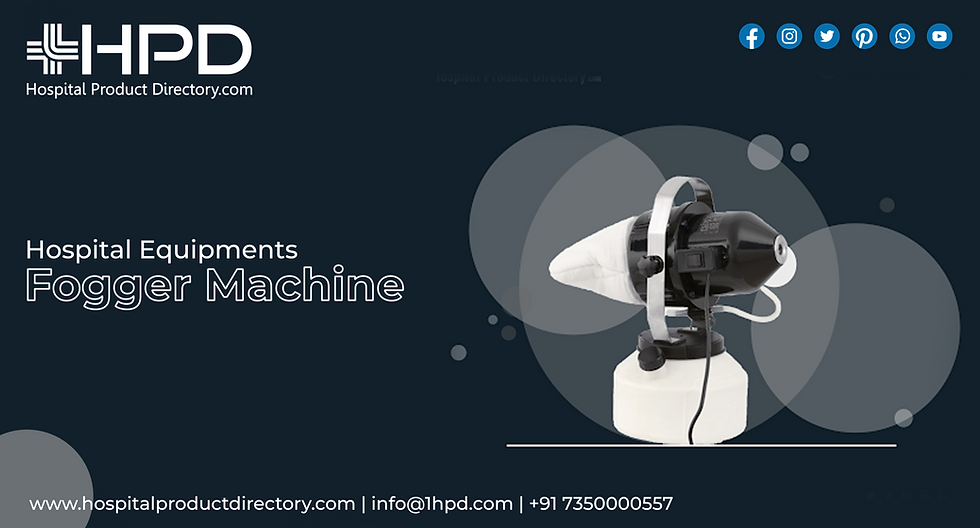
With people returning to offices and children returning to schools and colleges, the time has come for these establishments to evaluate their cleanliness and hygiene rules. As a consequence, disinfectant Fogger Machines made by Fogger Machine Manufacturers are being brought into use by several new businesses and establishments. In this article, we check out the different types of Fogger Machines, how they function, and whether they are the best for a business.
What does disinfectant fogging entail?
Disinfectant fogging includes drenching an entire room with microbial matter that can cleanse and eliminate pathogens from the air, as well as from exteriors within the room. This kind of large-scale fumigation process is classically carried out frugally in high-risk parts because of the danger of gasping the disinfectant solution, and the connected time it takes to carefully clean a room using this technique. Despite these disadvantages, disinfectant fogging is highly operative at fighting pathogens, chiefly those that are airborne or carried in respirational droplets, such as the flu virus or Covid-19.
How do the Fogger Machines function?
All foggers effort by filling the room with a mixture of disinfectant properties. There are several diversities of disinfectant fogger machines on the market with Fogger Machine Dealers, which deliver different kinds of fogging treatments. Selecting the right treatment for your facility will be contingent on its use, possible pathogen revelations, and the exteriors to be sanitized.
Chemical fogging
A chemical fogger can be a purpose-built, enduring structure in a workshop or granary, or a mobile unit transported into a workroom as required. Chemical foggers work by providing a fine haze of disinfectant solution until the air is supersaturated. This applies an even covering of mixture to all exteriors in the room, as well as sterilizes the air. The span of the treatment is contingent on the extent of the area being clouded, but characteristically takes 30-60 minutes to complete, with an added 60 minutes or more for the haze to dispel and the air in the room to return to breathable stages.
Vaporized hydrogen peroxide (VHP)
This is a common technique of disinfectant fogging used in remedial settings and pharmacological surroundings, for cleanrooms and similar. Washing with VHP includes the extra stage of dehumidifying the room, and takes lengthier to complete. Typically VHP lasts 2-4 hours fogging trailed by aerating with clean air to purify the room. Unlike chemical foggers, VHP fogging cannot enter organic biofilms and remains, and therefore is powerless to eliminate all microorganisms and pathogens. Ozone fogging
Ozone is an extremely responsive compound and as such is shaped at the point of use by passing air through a high-energy basis such as UV light. To treat a workroom with ozone, the room must be humidified before ozone production and dissipated with fresh air after the treatment. This kind of fogging typically takes 30-90 minutes from beginning to conclusion. The use of ozone as a fogging agent is usually ill-advised in parts with corrodible metals such as aluminum, zinc, copper, and iron. Individuals are mainly sensitive to ozone, and it is highly sensitive once it has entered the breathing tract, so extra safeguards need to be taken to air the room after fogging has been finished.
Chlorine dioxide (ClO₂) treatment
Chlorine dioxide is a good choice for fogging because the gas breaks down into inoffensive salts. Though, it is an unbalanced compound that has to be produced on location and needs strict temperature and humidity strictures that make it inappropriate for all purposes. Usually, chlorine dioxide is produced using sodium chlorite and chlorine gas, so there is an element of danger involved in running the harmful gas during this procedure.
Where can one use Fogger Machines?
Though antibacterial foggers have usually been used in manufacturing and medical locations, they are progressively common in every day cleaning situations. With global concern about viral communications, fogging for home use, workplaces, schools, COVID-19, and automobiles is becoming more prevalent. To be operative, fogging has to be approved out in bounded spaces that can be closed off for at least a couple of hours. Train cars, school buses, and emergency and personal automobiles are good surroundings for fogging, and this technique of fumigation can be faster and more effective than manual cleaning methods.
Before fogging any room or automobile with a home fogging kit, check for directions concerning the room scope and temperature and humidity limits. Trying to fog under the wrong circumstances can lead to the treatment being unsuccessful, as can fogging too big an area. Fogging too minor an area, though, can consequence in oversaturation and dangerous conditions.
In inference, fogging is a confirmed, effective technique of sterilizing a large area in a comparatively short period, but it isn’t a total washing solution. Fogging has a proven past within manufacturing settings and has many small business suggestions that will make it striking to companies looking to resuscitate and defend staff and clients during the COVID-19 epidemic. Though, fogging must always be carried out by a skilled professional in combination with other good hygiene and sanitation practices.


Comments